











- Common solutions for jersey logos
- How UV ink printed TPU logos work
- Why this solution matters more in the 2026 world cup cycle
- Conclusion: not a universal solution, but highly suitable for this market moment
As the 2026 World Cup approaches, the global sports apparel and merchandise market is expected to enter a new growth cycle. Co-hosted by the United States, Canada, and Mexico, the tournament will expand from 32 teams to 48 teams, bringing more matches, a longer schedule, and more diversified viewing and promotional scenarios.
For football jerseys, the team crest is more than a visual identity. It is one of the most frequently seen and touched elements on the garment. It must withstand repeated washing, stretching, friction, sweat, and close-up camera exposure. For manufacturers, the crest is also one of the most demanding parts of jersey production: it needs to look premium, remain durable, and support fast repeat orders or design updates within a short delivery cycle.

Common solutions for jersey logos
Current jersey logo production methods can generally be divided into two categories: printing directly onto fabric or applying a separate logo onto the garment.
Screen printing is suitable for large-volume production and solid-color designs. It offers cost advantages for mass orders, but when more colors are involved, plate costs increase and design changes become less flexible.
Heat transfer printing is more flexible for small orders and can deliver good color performance. However, larger designs may create a film-like feel, which can affect breathability and wearing comfort. Wash durability and long-term softness may also require careful control.
Sublimation printing provides a soft, almost hand-free feel on polyester fabrics and offers good breathability. However, it is more selective about fabric composition and base color, and it is often used during the cut-piece stage, making later repeat orders less convenient.
Embroidery and appliqué embroidery offer strong durability and a premium dimensional look, but fine lines, gradients, and complex details can be limited. Thin and elastic sports fabrics may also be more sensitive to stitching tension and backing materials.
Traditional silicone badges provide good elasticity, folding resistance, and a professional sportswear texture. However, they often require molds or multiple processing steps, making the production cycle longer and less friendly to small-batch customization.
How UV ink printed TPU logos work
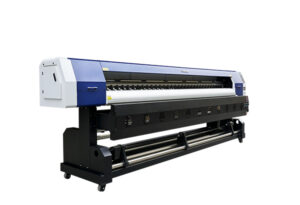
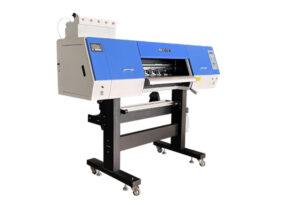
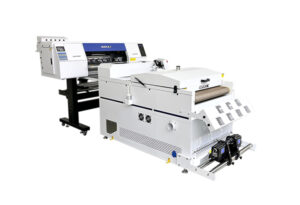
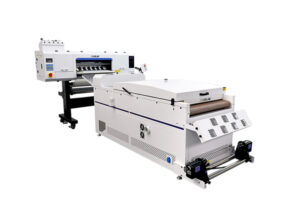
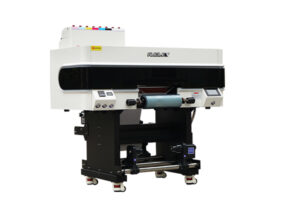
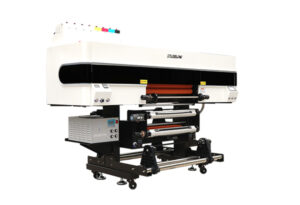
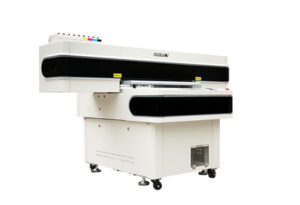
UV ink printing on TPU logos is a “make the badge first, then apply it to the garment” solution. Taking the Audley 9060 UV flatbed printer for TPU logo and 3D logo production as an example, the process can be summarized in three main steps.
First, the design is printed onto an adhesive-backed material. UV ink forms the image on the film or substrate and can create a certain level of thickness and embossed texture.
Second, the finished logo is aligned with the garment and placed on a heating table for preheating. This helps the material and adhesive reach a more stable bonding condition, reducing the risk of bubbles or edge lifting.
Third, the garment is heat pressed to complete the final bonding and shaping process, resulting in a finished product that can be prepared for shipment.
The biggest advantage of this method is that it changes logo production from a mold-driven or screen-driven process into a file-driven process. It also turns manual layering into one-step imaging with controllable thickness.
Why this solution matters more in the 2026 world cup cycle
1. Environmental compliance: better aligned with low-VOC production trends
As environmental regulations become stricter in many markets, volatile organic compounds, or VOCs, are becoming an important issue in manufacturing management. Traditional solvent-based inks or certain solvent-based coatings may increase pressure on production sites in terms of odor control and emissions management.
UV ink is cured by ultraviolet light and is generally associated with low-volatility, low-solvent, or solvent-free formulation directions. This helps reduce odor and makes VOC-related production control more manageable.
During a global event cycle such as the 2026 World Cup, sportswear brands and merchandise suppliers may face higher expectations regarding material compliance and sustainable production. In this context, UV printing’s lower-solvent characteristics make it a more future-oriented option rather than a temporary production choice.
2. Flexible manufacturing: a better response to expanded teams and diversified demand
With 48 teams and three host countries, the demand for sports merchandise is likely to become more fragmented, urgent, and diversified.
For design changes, manufacturers only need to update the digital file. There is no need to remake molds or plates, making it suitable for upgraded crests, commemorative editions, limited city editions, and fast design testing.
Small orders are also easier to start. Fan customization, youth teams, corporate viewing events, retail pop-ups, and local sports communities can all produce customized logo products with a lower entry threshold.
This method is also more garment-friendly. Producing the logo first and then heat pressing it onto the finished garment can reduce the risks often seen in direct thick-layer printing on apparel, such as fabric deformation, color differences, show-through, or higher rework rates.
In simple terms, UV ink printed TPU logos help reduce process complexity while improving delivery certainty. This is especially important under the tight timelines of major sports events.
3. Finished product experience: silicone-like texture with better wearing comfort
For fans and players, the requirements for a jersey crest are simple but strict: it should look premium on camera, remain stable during sweating and movement, resist cracking after repeated washing, and feel comfortable against the body.
UV printing can create a silicone-like visual and tactile effect, with a certain degree of thickness, matte texture, sharp details, and a dimensional finish that looks premium without being overly heavy.
When the material system is properly matched, TPU logos can offer good elasticity and folding resistance, helping the crest adapt to stretching around the chest or back area during movement and reducing the risk of cracking at fold points.
Comfort can also be improved through optimized design. For example, partial hollow structures, breathable layouts, thin-edge transitions, and suitable adhesive layers can help reduce the heavy, sealed, or uncomfortable feeling sometimes caused by large logo patches.
Conclusion: not a universal solution, but highly suitable for this market moment
The 2026 World Cup will bring more than global attention. It will also bring a more complex production rhythm: more teams, more design versions, more repeat orders, and stronger sustainability expectations.
UV ink printed TPU logos, also known as silicone-like TPU badges, provide a more digital way to produce jersey crests. With fewer solvent-related concerns, a shorter production chain, and more controllable texture effects, this solution can help meet the real market demand for logos that look premium, remain durable, and can be quickly reproduced.
It may not be the best solution for every fabric or every application. However, for small-batch multi-design jersey crest production, three-dimensional sportswear logos, and orders that require both visual quality and delivery flexibility, its value becomes especially clear during the 2026 World Cup cycle.