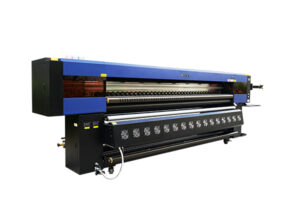
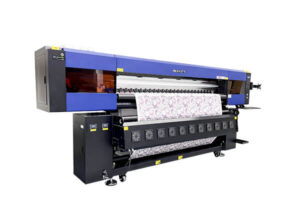
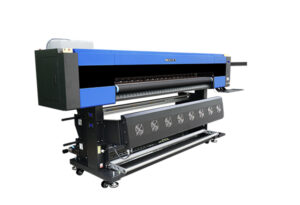
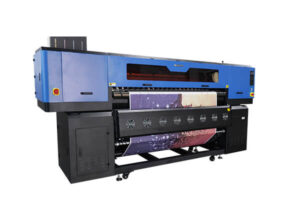



Starting a garment printing business does not always require investing in a large industrial production line. For many small printing studios, growing businesses, and garment decoration suppliers, finding a balance between equipment cost, print quality, and daily operating convenience is more important.
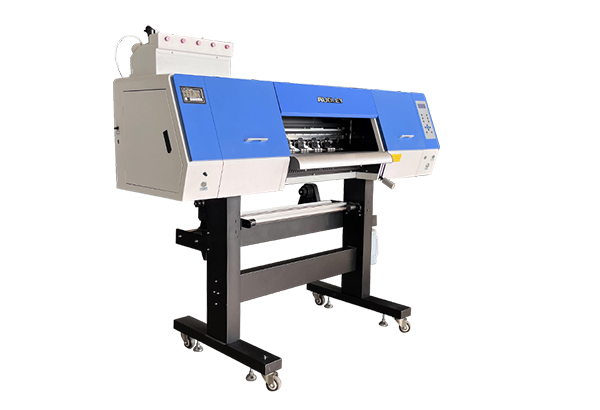
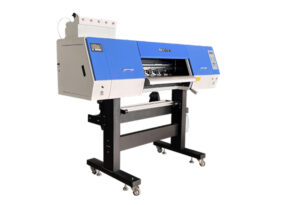
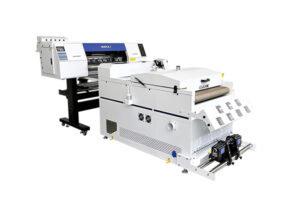
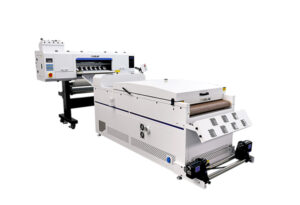
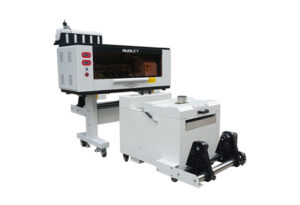
An economical DTF printer offers a practical way to enter the direct-to-film printing market. With a dual-head configuration, separate color and white ink printing, convenient external ink bottles, and an automatic powdering and curing system, this solution brings several essential production functions together.
Rather than focusing on complicated configurations, the goal is to provide a straightforward printing workflow that helps businesses handle everyday garment decoration orders.

1. Why Choose an Economical DTF Printer?
When choosing a DTF printing machine, buyers often compare more than the initial purchase price. They also consider ink replenishment, film feeding, operating procedures, maintenance requirements, and the supporting powder shaker.
For a small or medium-sized printing business, equipment that is easy to understand and operate can make daily production more manageable.
This dual-head DTF printing solution focuses on several practical features:
- Separate color and white ink printing
- External ink bottles for convenient replenishment
- Adjustable film feeding tension
- Direct button-based operation
- Adjustable heating temperature
- Automatic powder application and excess powder removal
These features cover the essential stages of a conventional DTF production workflow.
For businesses entering garment decoration or adding DTF printing to an existing service portfolio, a practical configuration can be a sensible starting point.
2. Dual-Head Printing for Color and White Ink
Color reproduction and white ink coverage are two important factors in DTF printing.
This economical DTF printer adopts a dual-head configuration, with separate printheads assigned to color and white ink printing.
The color printing stage produces the visual design, including text, illustrations, patterns, and multicolor graphics. The white ink layer provides the necessary backing for transfer designs, particularly when printing artwork intended for dark-colored garments.
This separation allows the two printing stages to perform their respective functions within the same production workflow.
For printing businesses, the quality of the final transfer depends on several factors, including ink compatibility, film quality, RIP settings, and printing parameters.
When evaluating a machine, it is worth checking both fine graphic details and white ink coverage. Small text, thin lines, color transitions, and solid white areas can reveal how well the printing configuration performs.
A proper sample test is always more useful than judging a machine by its specifications alone.
3. Convenient Ink Supply and Adjustable Film Feeding
Daily operation is another important consideration for printing businesses.
The machine uses external ink bottles, making it easier for operators to observe the ink supply and replenish ink when necessary. The visible ink supply condition also helps users check the machine before starting a printing job.
Film feeding is equally important.
The dancer-bar film feeding system allows operators to adjust film tension according to the material and production requirements. Proper tension helps maintain smooth film movement and reduces feeding problems caused by unsuitable tension settings.
The machine also uses a button-based control panel. Its straightforward layout makes common operations easier to understand, especially for operators who prefer direct physical controls.
In addition, the heating temperature can be adjusted to suit different production conditions.
These practical details may appear simple, but they contribute to a more organized daily workflow.
4. Print Quality: Check the Details Before Production
A good-looking transfer starts with accurate printing.
When testing a DTF printer, businesses should pay attention to more than the overall appearance of a sample. Fine lines, small lettering, color transitions, and white ink coverage all deserve attention.
For example, detailed logos and decorative graphics often contain narrow outlines and small elements. If these details are not reproduced clearly, the finished garment may not achieve the desired appearance.
White ink performance is another important consideration. A consistent white backing helps maintain the appearance of colors when designs are transferred onto dark fabrics.
We recommend testing several types of artwork before confirming a machine configuration:
- Small text and fine graphic lines
- Multicolor illustrations
- Gradient color patterns
- Large solid-color areas
- White-backed designs
These five sample categories provide a useful starting point for evaluating printing performance.
Actual results will depend on the selected ink, film, RIP configuration, and printing settings.
5. Automatic Powdering and Adjustable Curing
After printing, the film moves into the powdering and curing stages.
The automatic powdering system distributes hot-melt adhesive powder over the printed areas. The shaking mechanism then removes excess powder, helping keep the material cleaner before curing.
Proper powder application matters because uneven powder distribution can affect the final transfer appearance and bonding performance.
The curing section provides adjustable temperature and operating speed, allowing operators to match the settings to the selected film, adhesive powder, and production requirements.
Finding the right combination is important.
Too much powder, insufficient powder, or unsuitable curing conditions may affect transfer quality. Therefore, operators should test the complete process rather than adjusting individual settings without considering the entire workflow.
A typical production sequence includes:
- Load the DTF film.
- Prepare the artwork and printing settings.
- Print color and white ink.
- Apply adhesive powder automatically.
- Remove excess powder.
- Cure the printed film under suitable conditions.
By connecting these stages, the printer and powder shaker form a practical production solution for garment decoration businesses.
8. A Practical DTF Printing Solution for Growing Businesses
An economical DTF printer is worth considering for businesses that want to establish or expand their garment transfer production without immediately investing in a more complex industrial setup.
The AUDLEY dual-head solution combines separate color and white ink printing, external ink bottles, dancer-bar film feeding, button-based controls, automatic powdering, and adjustable curing.
These functions address several everyday production requirements in one coordinated workflow.
However, choosing the right machine still depends on your business needs. Before purchasing, consider your expected order volume, required printing width, preferred film type, ink consumption, available workspace, and after-sales support.
It is also important to request actual sample prints and confirm the complete machine configuration before placing an order.
At AUDLEY, we focus on developing and manufacturing digital printing equipment for businesses around the world. Our team can help customers understand different configurations and select suitable equipment according to their production requirements.
Looking for an economical DTF printing solution?
Contact AUDLEY to request the dual-head configuration, sample printing results, and a quotation for your market.
Start with the right equipment and build your garment printing business step by step.